

ehs-hospital.info
GUIDANCE FOR TREATING PATIENTS WITH EHS/ ER-SYNDROME/ MR-SYNDROME – ENGLISH TRANSLATION
People reporting hypersensitivity to electromagnetic waves are susceptible to particular discomfort during hospitalisation, for example due to proximity to sources of electromagnetic radiation.
Management of this person must take into account the constraints linked to urgency, organisation, and the delivery of care.
General Directorate of Health (May 2014)
PRECAUTIONS
TO TAKE IN
THE CARE UNIT
Install the person away from electromagnetic waves as much as possible and rapidly if possible.
In the room:
Prefer a room without Wi-Fi (turn off Wi-Fi).
Single room preferred.
Remove mobile phones, cordless phones (baby monitors), and any nearby transmission sources.
Switch off Wi-Fi for the entire duration of care.
IN THE ROOM
Do not place electrical outlets and power cables near the bed, as they generate electric and magnetic fields.
Install the bed canopy and protective fabric against low frequencies if possible.
Unplug anything that can be turned off (TV, lamps, etc.).
Move any unnecessary electrical devices away from the bed.
Place devices emitting waves (e.g. Wi-Fi routers) as far away as possible (more than 3 metres).
Provide care quickly; EHS patients are in discomfort in hospital environments and are exposed to electromagnetic waves despite precautions.
Clearly record in the patient’s file that they are EHS and possibly chemically sensitive, along with the coordination details of a close contact.
Provide written instructions so the patient can repeat them in case of exposure to waves.
PRECAUTIONS
DEPENDING ON
MEDICAL OR PARAMEDICAL
CARE
Do not use mobile phones, tablets or laptops inside the room.
Leave nursing PCs outside the room.
Do not use electric infusion pumps but instead traditional gravity perfusion if possible.
Avoid electric suction devices.
Use oxygen if needed; this helps the brain to recover better.
PRECAUTIONS
WHEN TRANSFERRING
TO OPERATING
BLOCK OR EXAMINATION
OUTSIDE
THE ROOM
The EHS patient must remain in their bed, protected by their canopy. If possible, cover them with anti-wave fabric (including the mattress).
Avoid equipment emitting waves.
In the operating theatre: minimise electrical equipment where possible.
Anaesthesia:
Electrohypersensitivity and allergy to chemical products are often linked; use anaesthesia without gas (no fluorinated hydrocarbons).
MRI:
Avoid as much as possible for EHS persons because of intolerance to magnetic fields.here...
ASSEMBLY OF
A CANOPY
IN ANTI-WAVE
FABRIC
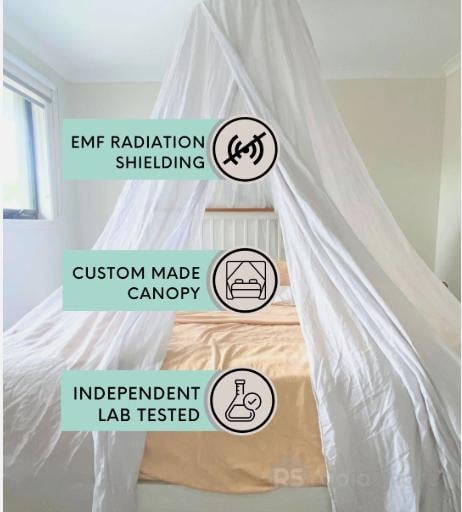
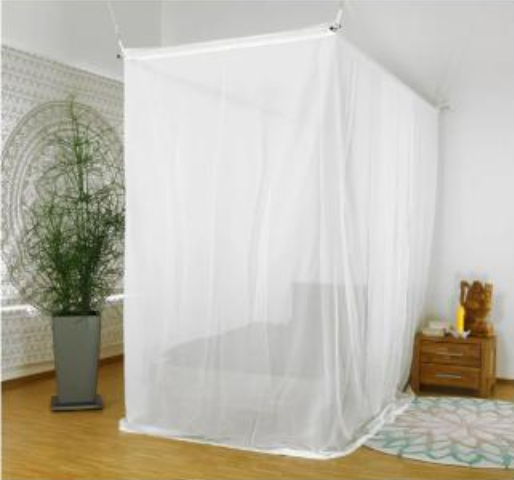
Place materials on the bed. Restore the anti-wave canopy over the bed. The fabric should hang 40 cm beyond the bed on each side.
Attach the canopy to available supports. The fabric must extend to the floor.
Close the canopy fully and carefully seal all sides.
Take measurements to ensure the effectiveness of high and low frequency attenuation.
IMPORTANT: After opening one side of the canopy for care, ensure it is fully closed again; high frequencies re-enter inside the canopy very quickly.
ELECTRO-HYPERSENS
ITIVITY
(EHS)
Electrohypersensitivity is the manifestation of biological intolerance to electromagnetic fields.
Symptoms cited:
Headaches, intense fatigue
Concentration problems
Skin sensations
Heart rhythm disturbances
Pain
Dizziness
Anxiety
Tolerance levels vary between individuals.
Document reference:
POEM 26 – Prevention of Electromagnetic Waves – www.poem26.fr
Antenna location maps and emission measurements: www.cartoradio.fr
[Translated from the French]